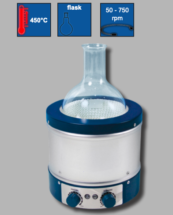
The heating mantle is a device used for heat transfer in containers as an alternative form of a heated water bath. In contrast to other heating devices such as heating plates, glass containers can be placed in such a way within the thermal jacket that, while being in direct contact with the walls, the risk of breakage does not increase. This happens because the heating element of the device interposes insulating material from the object, resulting in the avoidance of the development of very high temperatures.
Heating mantles can take various forms. In the most common case, we encounter electric wires embedded in some fabric that surrounds the container. The voltage transmitted to the device and consequently the temperature achieved is regulated by a special rheostat. This type of thermal jacket is mainly used to maintain a specific temperature in the sample after some reaction, perhaps.
Another type of thermal jacket resembles a cylindrical basket, commonly made of plastic or aluminum. What rigid outer casing serves as a support for a fabric in the shape of a basket that also contains the heating elements. In this case, we simply place the sample in the device's slot.
In contrast to water or oil baths, the use of a heating mantle does not leave residues on the container and heats the container uniformly, reducing the risk of overheating specific points on the surface of the sample.
The container capacities that these devices can accommodate range from 50 ml to 22 liters; in some cases, the capacity can be adjusted, and they can combine the functions of heating and stirring. They can also achieve temperatures of up to 450°C, and very often the operation is controlled via a microprocessor.
 English
  Greek
Greek